Intersectionality
Intersectionality refers to how a person’s multiple identities (such as gender, race, ethnicity, disability, age, migration status, sexual orientation, and class) combine to shape both experiences of harm and access to justice. In other words, two people may experience the “same” crime differently because of how their identities overlap and how systems treat them.
In the realm of international criminal justice, applying intersectionality means recognising that survivors of atrocity crimes are not only harmed by a single axis of oppression. For example, a woman from an ethnic minority who is displaced may face sexual violence, but her harm is magnified by her ethnicity, her displacement status, and gendered norms. A person with disability may face barriers in evidence giving or witness protection that others do not.
At Women’s Initiatives for Gender Justice, we treat intersectionality not just as a concept but as a practical operational lens. We seek to ensure that investigations, prosecutions, adjudications, and reparations in the International Criminal Court (ICC) and related mechanisms are designed, implemented, and reviewed in ways that account for overlapping discrimination and layered vulnerabilities.
Why This Matters
Survivors often face compounded harms, not just because of what happened to them, but because of who they are (or are perceived to be). Justice must reflect those layered realities to truly respond to their needs and agency.
Embedding intersectional justice advances the Rome Statute system’s human-rights mandate (such as through Article 21) and helps strengthen jurisprudence by recognising diversity in harm, identity and participation.
Applying intersectional thinking transforms justice institutions, making them more inclusive, legitimate and effective in addressing structural discrimination, not just individual acts of harm.
What we do on Intersectionality
Legal Research & Analysis
We integrate an intersection lens throughout our legal research and analysis. Our report “Judicial Approaches to Sexual and Gender-based Crimes at the International Criminal Court” provides a rigorous review of how the ICC has handled sexual and gender-based crimes (SGBC), identifies shortcomings in intersectional and gender-competent adjudication, and offers concrete recommendations for change.
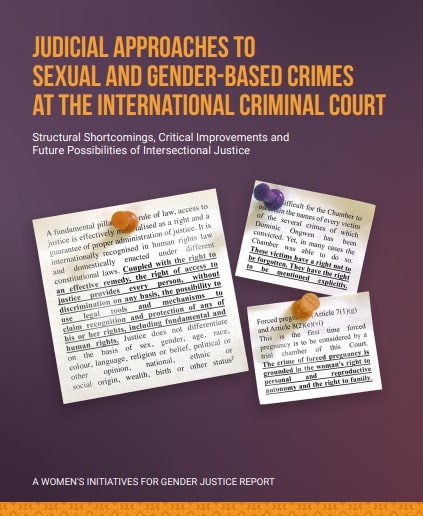
Judicial Approaches to Sexual and Gender-based Crimes at the International Criminal Court
Advocacy & Campaigns
We advocate to embed intersectional and substantive justice approaches within the work of the International Criminal Court and related accountability mechanisms, with a focus on ensuring that layered identities and harms are meaningfully recognised in legal reasoning, prosecutorial strategy, reparations, and institutional practice, rather than treated as peripheral or incidental.
We engage with judges, prosecutors, and policy actors to support capacity-building and reflective practice on intersectionality, including through dialogue, legal analysis, and contributions to discussions on representation, participation, and data collection. This work aims to strengthen how international justice institutions understand and respond to discrimination that operates across multiple, intersecting axes.
Recent engagements include analysis of how Colombia’s Special Jurisdiction for Peace has integrated survivor-led intersectional approaches in transitional justice; amicus curiae submissions in the Al Hassan reparations proceedings calling for recognition of gendered and intersectional harm; and legal analysis of the Abd-Al-Rahman judgment, emphasising the need for comprehensive intersectional reasoning in cases involving gender persecution and discrimination.
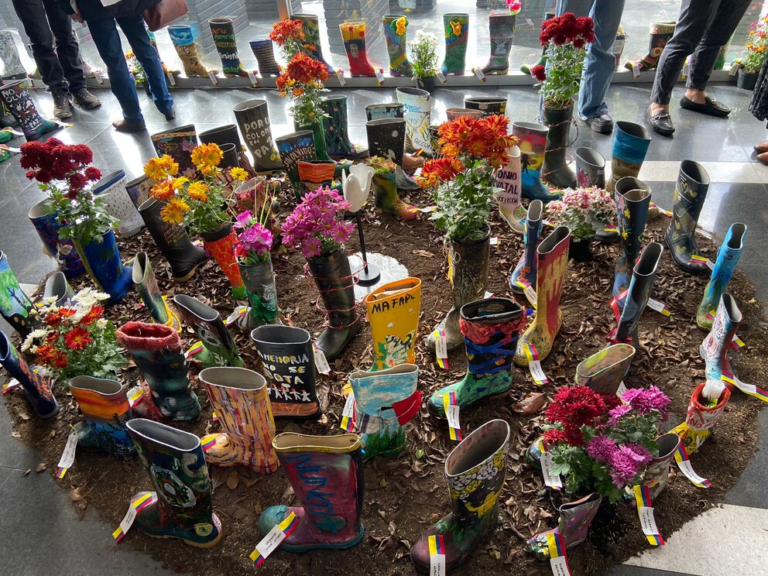
Colombia is setting a path for intersectionality, survivor agency and restorative justice | LSE Blogs
Solidarity & Network-Building
Our intersectional work grows from collaboration with feminist practitioners and partners advancing justice in contexts where identities and inequalities converge.
We work alongside civil society and academic allies developing intersectional frameworks for gender-based and identity-based crimes, including those leading transitional justice processes such as the Special Jurisdiction for Peace (JEP) in Colombia, whose approach to restorative and intersectional justice informs our advocacy across the Rome Statute system.