Gender Persecution
Gender persecution means the deliberate, systematic, and severe denial of fundamental human rights to individuals or entire groups, on the basis of gender (including identity, expression, sexual orientation) or the combination of gender plus other status (race, religion, ethnicity, disability, migration status etc.).
Unlike isolated acts of violence, gender persecution is characterised by patterns of discrimination and rights-deprivation that are embedded in larger systems of power, such as conflict, occupation, authoritarian rule, or other atrocity settings.
It covers not only acts of sexual violence, but also the removal of access to education, freedom of movement, employment, assembly, health services, and political representation, where those deprivations are shaped by gender-based discrimination. For example, laws or practices that forbid women or LGBTQI+ persons from attending school, require forced labour from persons because of their gender identity, or systematically target a gendered group for extermination, fall within the concept of gender persecution.
In the context of international law, gender persecution is formally recognised as a crime against humanity under the International Criminal Court’s (ICC) founding treaty, the Rome Statute of the ICC (Article 7(1)(h): persecution). However, despite this recognition, application of gender persecution has been limited historically.
Women’s Initiatives for Gender Justice advocates for a survivor-informed, intersectional vision, recognising that gender persecution often overlaps with other forms of discrimination (race, ethnicity, religion, disability, sexual orientation).
Meaningful redress should include prevention, protection, participation of survivors, and recovery, as well as criminal accountability.
Why this matters
Beyond physical violence, survivors experience a profound loss of rights concerning their education, livelihood, bodily autonomy, community belonging. Recognising gender persecution centres survivors’ agency and need for holistic justice and recovery.
See moreHolding perpetrators to account under the Rome Statute (via the International Criminal Court), as well as domestic and regional human rights/courts, strengthens the rule of law and sends the message that gender-based rights-deprivation is a grave crime.
See moreAddressing gender persecution helps dismantle structural discrimination (gender-based, racial, ableist, colonial) and build inclusive justice systems that protect all persons and communities, deepening legitimacy and responsiveness of legal and accountability frameworks.
See moreWhat we do on Gender Persecution
Legal Research & Analysis
In November 2024, Women’s Initiatives for Gender Justice submitted detailed recommendations to the ICC Office of the Prosecutor, developed in partnership with gender justice practitioners.
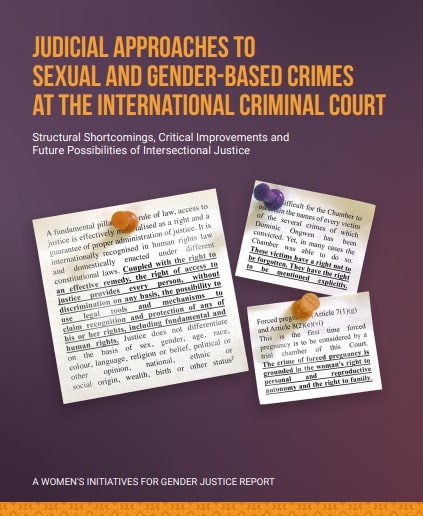
We produce research briefs, explanatory guides, amicus curiae submissions, and legal analysis reports that examine: the crime of gender persecution, gaps in accountability, how to embed intersectionality, and how to link domestic, regional and international mechanisms.

Gender Persecution Principles
Advocacy & campaigns
Our work advocacy work focuses on ensuring that persecution on gender grounds is understood and addressed as a serious international crime, and that legal frameworks provide effective prevention, protection, and accountability.
Central to this advocacy is the meaningful and safe participation of survivors and civil society in transitional justice, accountability, and reparations processes. We work to ensure that survivor experiences and intersectional harms inform legal standards and practice, and that justice processes respond to the structural nature of persecution.
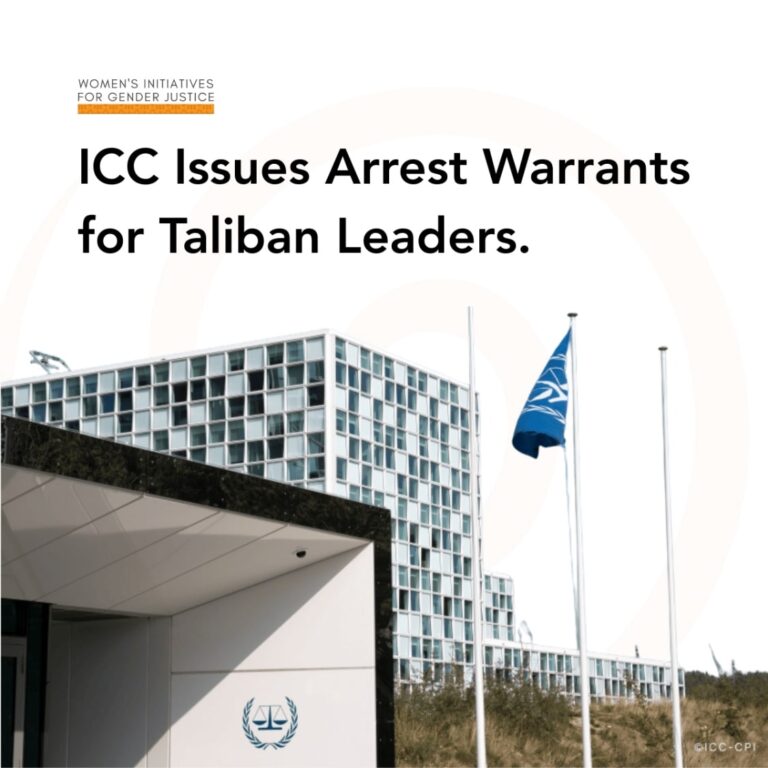
We also support the development of international standards on gender persecution, including the finalisation of the International Criminal Court’s forthcoming Principles on the Crime of Gender Persecution. Recent engagements include a public statement following the ICC’s first conviction for gender persecution in the Abd-Al-Rahman judgment, and the co-sponsorship of a side event at the 2024 Assembly of States Parties focused on advancing the Gender Persecution Principles.
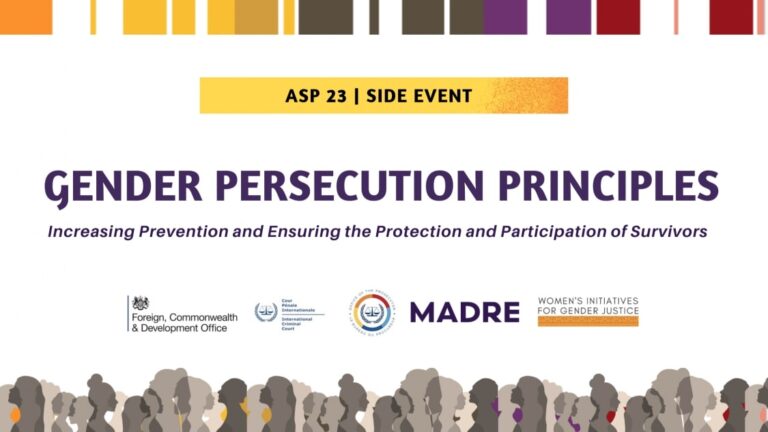
ASP Side Event | Gender Persecution Principles
Solidarity & Network-Building
We work in partnership with gender justice experts and survivors’ organisations across regions. Our approach emphasises power-sharing: we centre survivors’ expertise and support local leadership and capacity-building.
Through convenings and collaboration, we help bring survivor-informed and intersectional perspectives into dialogue with international justice institutions.
This includes contributing to civil society consultations and forums linked to the development of the International Criminal Court’s Principles on the Crime of Gender Persecution, ensuring that emerging standards are informed by lived experience and collective expertise.
Impact
We submitted comprehensive civil society recommendations to the International Criminal Court Office of the Prosecutor in November 2024, informing the development of the forthcoming Principles on the Crime of Gender Persecution.
We contributed to and supported multi-continent civil society convenings on gender persecution (Bogotá, Winnipeg, Johannesburg, Tasmania, and The Hague), helping shape the drafting agenda around prevention, protection, survivor participation, and relief and recovery.
We strengthened the integration of intersectional analysis and survivor-centred policy design in gender persecution advocacy, including attention to safe participation, structural discrimination across multiple axes, and inclusive approaches to reparations and justice processes.