Our Vision and Mission
International justice systems still mirror the inequalities they seek to address. Patriarchal and colonial structures shape how harm is defined, whose voices are heard, and whose justice counts. Survivors—especially women, LGBTQI+ persons, and others facing intersecting oppression—continue to be excluded from meaningful accountability.
Too often, the law focuses narrowly on violence, overlooking the wider spectrum of gender-based harm—from reproductive violations to institutional discrimination. Power and resources remain concentrated in the Global North, sidelining feminist leadership and lived expertise from affected communities.
Without transformation, international law risks reinforcing injustice instead of repairing it.
We exist to change that.
Women’s Initiatives for Gender Justice (WIGJ) is an international feminist organization based in The Hague advancing a gender-just world through the law.
Founded in 2004 to continue the legacy of the Women’s Caucus for Gender Justice, we bring more than two decades of experience shaping gender-sensitive international criminal law and holding power to account for gender-based harm.
Our vision is a gender just world through the law
Our mission is to drive change in the international justice system by advancing accountability for gender-based violence/harm and advocating for inclusive, survivor-sensitive justice for all. We champion intersectional, people-centred, and transformative approaches that challenge inequality, reshape harmful systems, and promote solidarity through power-sharing and collaboration. Through equitable access to knowledge, innovation, and survivor-led expertise, we work to build a more just, gender-responsive world.
How we work
At Women’s Initiatives for Gender Justice, we believe that advancing justice for survivors of gender-based violence requires expertise, strategic action, and solidarity. We deliver impact through three key strategies: rigorous legal analysis, direct advocacy, and collective movement-building. Together, these approaches challenge inequality and drive systemic change.
1. Legal monitoring and research: We provide leading analysis and research on gender justice within international criminal law. By monitoring legal developments and producing thought-leading publications, we ensure that gender-based crimes are effectively recognized and addressed in global justice systems.
2. Advocacy: With 25 years of expertise and deep-rooted influence, we engage directly with international courts, policymakers, and global institutions to shape legal and policy frameworks. Through strategic interventions, we push for survivor-centred approaches, stronger accountability mechanisms, and the dismantling of structural barriers to justice.
3. Solidarity through Power-sharing, Collaboration and Network Building: We leverage our expertise, influence, and access to connect diverse stakeholders—survivors, activists, legal experts, and policymakers—around a shared vision of gender justice. Recognizing our own positionality and privilege within international justice spaces, we actively work to share power and resources, foster cross-movement collaboration, and amplify the leadership of those most affected by violence and inequality.
Legacy
Our roots lie in a historic success: ensuring that gender-based crimes were recognized in the Rome Statute of the International Criminal Court (ICC). Today, we build on that legacy by mobilizing new generations of advocates, lawyers, and survivors to reimagine what justice looks like—beyond narrow definitions of violence, and toward the recognition of harm in all its form.
For over two decades, Women’s Initiatives for Gender Justice (WIGJ) has worked to make equality, accountability, and survivor-centered justice central to international law.
Why This Work Matters
Gender-based violence and discrimination continue to shape conflict and post-conflict realities. Survivors face not only direct harm but also systemic exclusion from justice processes.
WIGJ works to change this reality by:
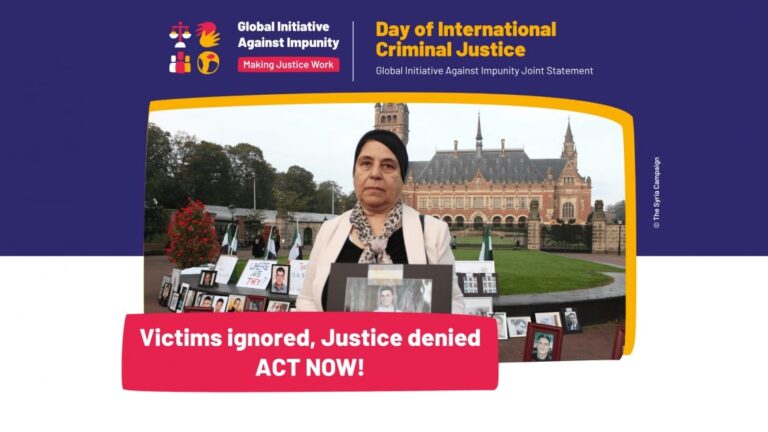
- Challenging impunity for sexual and gender-based crimes before international and national courts.
- Transforming legal norms to reflect lived experiences and intersectional identities.
- Building collective power among survivors, advocates, and practitioners worldwide.
Our Approach
Our work is rooted in feminist, intersectional, and decolonial principles and guided by survivor agency, consent, and care.
1. Evidence-based advocacy
We conduct legal and policy research that exposes gendered harms, identifies accountability gaps, and shapes reforms in ICL.
2. Capacity building
We equip judges, lawyers, investigators, and policymakers with the tools to apply gender-competent and survivor-centered approaches.
3. Collaborative networks
We convene and coordinate feminist actors—from grassroots organizations to international institutions—to strengthen collective advocacy and impact.
Our Legacy and Leadership
WIGJ was established in 2004 to continue the momentum of the Women’s Caucus for Gender Justice (1997–2003), which successfully ensured that sexual and gender-based crimes were recognized in the Rome Statute.
Since then, WIGJ has evolved into a leading organization in feminist international criminal law. As host of the Coalition for the ICC Secretariat since 2021, we coordinate multi-partner initiatives, manage global civil-society engagement, and ensure safeguarding and financial compliance across diverse consortia.
Our leadership draws on:
- Historical precedent – The Women’s Caucus demonstrated the power of coordinated feminist legal advocacy to change global norms.
- Organizational experience – Over two decades managing complex partnerships and advancing accountability mechanisms.
- Research and practice – Evidence showing that safety, participation, and protection are mutually reinforcing in effective human rights defense.
- Regional partnerships – Collaboration with trusted allies such as the Centre for Human Rights (Pretoria), JurFem (Ukraine), Synergy for Justice (Syria/Netherlands), Civil Rights Defenders (Latin America), and Manushya Foundation (Thailand), each contributing regional expertise in feminist organizing under restrictive conditions.
Our Values
- Survivor-centered: Survivors guide our work and shape our priorities.
- Intersectional: We recognize that gendered harms intersect with race, class, sexuality, disability, and identity.
- Feminist and decolonial: We confront power imbalances within justice systems and within the international community itself.
- Collaborative: We build solidarity across borders and disciplines to amplify collective impact.
- Accountable: We commit to transparency, ethical storytelling, and responsible advocacy.
Our Focus Areas
Transforming legal standards
We influence the interpretation and implementation of international law to reflect gender-sensitive, survivor-centered standards.
Advocating for survivors
We ensure survivors’ experiences inform legal and policy reform, addressing intersecting forms of discrimination and vulnerability.
Influencing legal systems
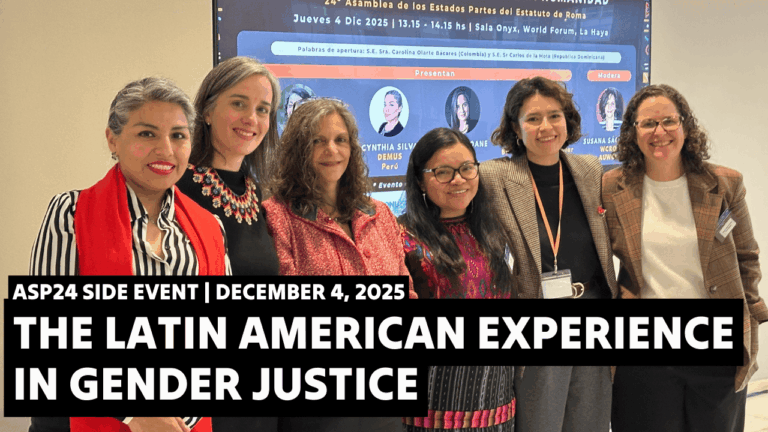
We engage institutions like the ICC and States Parties to promote gender competence, inclusivity, and accountability in practice.
Recent Advocacy Highlights
-
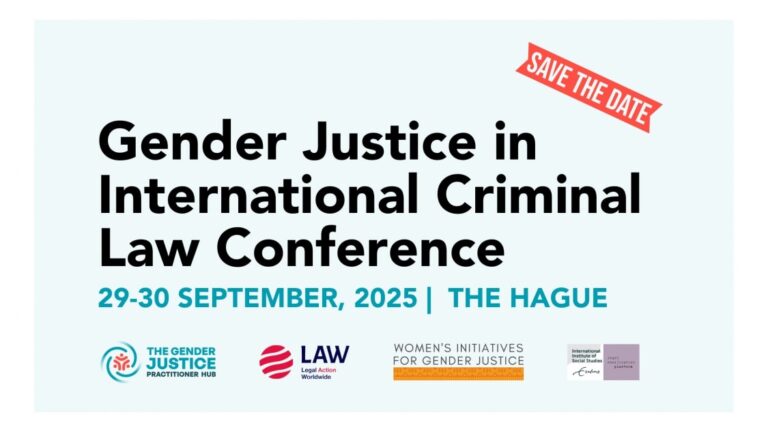
Our 2024 flagship conference gathered more than 290 experts—judges, lawyers, scholars, activists, and survivors—to address reproductive violence in international law. Discussions underscored the need for intersectional strategies and survivor-led approaches to tackle forced pregnancies, sterilizations, and denial of reproductive healthcare.
-
We co-developed emerging principles to guide the recognition and prosecution of gender persecution, drawing lessons from Afghanistan, Iran, and other contexts.
-
Through our Call It What It Is campaign, we helped establish these principles to clarify diverse forms of sexual violence and strengthen survivor-centered responses worldwide.
Find out more.
-
We advocate for recognition of sexual violence as a tool of oppression in detention, urging the ICC to prosecute acts such as forced nudity and sexual humiliation as Rome Statute crimes.
Find out more.
-
Our shadow report exposed systemic stigma facing survivors of sexual violence in Ukraine, calling for sustained judicial training and victim-centered procedures.
Find out more.